

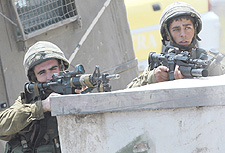
The Israeli occupation army has long been known to have a book of unwritten rules as concerns its open-fire regulations and a "Code of Silence" among its soldiers, in order to be able to exhonerate them from the killing of innocent and unarmed civilians in the occupied West Bank and Gaza Strip, the most glaring example being that of Iman al-Hims, and just last week, Amer Basyouni of the al-Ain refugee camp.
In a new video,the Israeli human rights groups B'Tselem provides testimonies of soldiers speaking about their Open-Fire Regulations. The testimonies show that soldiers receive intentitonaly ambiguous orders about when and how they are to use their weapons, giving the soldiers flexiblity, a high civlian death toll, and immunity from responsiblity. It is a policy Btselem calls "lethal ambiguity".
In one segment, a soldier speaks about the army’s policy in Hebron: "The Palestinians would open fire… In response, the army would take a controlling position and set up machineguns. Our job as machine-gunners was to respond… Machineguns are not precise weapons. You fire the first volley, see what it hits, and based on that adjust the aim… There were cases in which the army opened machinegun-fire and hit the roof of a hospital with a grenade…
"All these orders are grounded on a simple assumption: it is unacceptable that Palestinians will fire and we, the army, remain silent… [The soldiers] would take revenge. Go to Abu Sneneih or Harat a-Sheikh and shoot from real close… and when that didn’t help, fire at property as a deterrent."
Btselem says that while in the past, Open-Fire Regulations only covered law enforcement, with the outbreak of the second Intifada, the Israeli government instituted significant changes in the regulations and made them more "ambiguous":
"The army no longer gave soldiers a printed copy of the regulations, and they greatly expanded the kinds of situations in which soldiers were allowed to use their weapons. Israeli security forces have killed at least 1,806 Palestinians who were not taking part in the hostilities at the time they were killed. The vagueness of the orders given to soldiers on when to open fire is one of the principal causes for the high number of casualties. [T]he general practice is of not investigating cases of the killing of civilians who were not taking part in the hostilities. This situation transmits a grave message to the soldiers of contempt for the most basic human right, the right to life."
According to an Israeli army reservist I spoke with, even if soldiers are punished for torture or murder, it is symbolic at best: "“If there is a trial, [it] will be only the [solider] and the battalion commander…its what they call ‘discipline’…the soldier hears out [the commander] and says to him ‘ok sure’ then spends 7 days in prison and no one except the unit will know about it, including the press.”
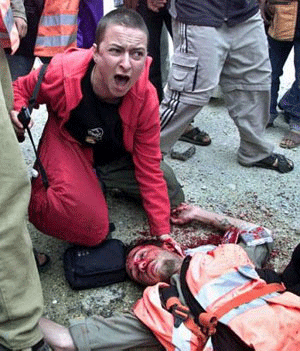
21-year-old Tom Hurndall spent 9 months in a coma before dying from gunshot wounds to his head. He was shot by an Israeli sniper when he tried to bring Palestinian children to safety.
B’Tselem says such “offensive sentences”, together with the Israeli Judge Advocate’s Office’s new policy of limiting the number of criminal investigations during this Intifada, contribute to a sense of immunity and transmit a message to officers and soldiers that “even if you violate the regulations and harm innocent persons, it is extremely unlikely that you will be punished.”
The policy of amiguity applies equally to Gaza's border "killing zone"-where 9 unarmed Palestinians, including five children, and and one eight-month old child, have been killed since the Disengagement:

9-year-old Aya al-Astal was killed by Israeli snipers stationed on Gaza's borders on her way back home to her village of Qarrara in south-east Gaza. No investigation was every made into her death.
"According to B'Tselem's recent research, the army made no attempt to warn the Palestinians to move further away from the fence, or to give them a chance to surrender.
There has been talk in the media of killing zones. The claim is that there are areas in which the soldiers are ordered to open fire at any person who enters, regardless of the circumstances. IDF officials have denied that any such order has been given. However, the nine cases in which Palestinians have been killed raise the suspicion that broad stretches of land near the Gaza perimeter fence have indeed been classified as "killing zones."
Here is the testimony one one of the victim's (16-year-old Sayyed Abu Libdah) cousins, who was killed while in his family's orchard, 600 metres away from the border.


0 коммент.:
Speak up your mind
Tell us what you're thinking... !